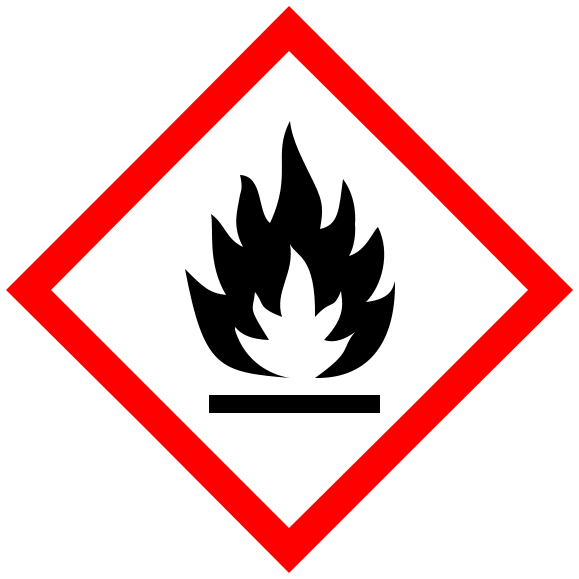
- Code
- GHS02
- Symbol
- Flame
- Hazard
- Flammable
- Signal word
- Danger Warning
What it means
The flame marks flammable materials: gases, aerosols, liquids and solids that catch fire easily, plus pyrophoric, self-heating and water-reactive substances and some self-reactive substances and organic peroxides.
For liquids the category follows the flash point and boiling point: the lower the flash point, the more severe the category and the stronger the signal word.
Hazard classes that trigger it
Classification in any of these categories puts GHS02 on the label, taken from the CLP label elements. A category with no signal word carries the pictogram alone.
| Category | H | Hazard statement | Signal word |
|---|---|---|---|
| Flammable gases | |||
| Flam. Gas 1 | H220 | Extremely flammable gas. | Danger |
| Aerosols | |||
| Aerosol 1 | H222 | Extremely flammable aerosol. | Danger |
| Aerosol 2 | H223 | Flammable aerosol. | Warning |
| Flammable liquids | |||
| Flam. Liq. 1 | H224 | Extremely flammable liquid and vapour. | Danger |
| Flam. Liq. 2 | H225 | Highly flammable liquid and vapour. | Danger |
| Flam. Liq. 3 | H226 | Flammable liquid and vapour. | Warning |
| Flammable solids | |||
| Flam. Sol. 1 | H228 | Flammable solid. | Danger |
| Flam. Sol. 2 | H228 | Flammable solid. | Warning |
| Self-reactive substances and mixtures | |||
| Self-react. B | H241 | Heating may cause a fire or explosion. | Danger |
| Self-react. CD | H242 | Heating may cause a fire. | Danger |
| Self-react. EF | H242 | Heating may cause a fire. | Warning |
| Pyrophoric liquids | |||
| Pyr. Liq. 1 | H250 | Catches fire spontaneously if exposed to air. | Danger |
| Pyrophoric solids | |||
| Pyr. Sol. 1 | H250 | Catches fire spontaneously if exposed to air. | Danger |
| Self-heating substances and mixtures | |||
| Self-heat. 1 | H251 | Self-heating: may catch fire. | Danger |
| Self-heat. 2 | H252 | Self-heating in large quantities; may catch fire. | Warning |
| Substances/mixtures which in contact with water emit flammable gases | |||
| Water-react. 1 | H260 | In contact with water releases flammable gases which may ignite spontaneously. | Danger |
| Water-react. 2 | H261 | In contact with water releases flammable gases. | Danger |
| Water-react. 3 | H261 | In contact with water releases flammable gases. | Warning |
| Organic peroxides | |||
| Org. Perox. B | H241 | Heating may cause a fire or explosion. | Danger |
| Org. Perox. CD | H242 | Heating may cause a fire. | Danger |
| Org. Perox. EF | H242 | Heating may cause a fire. | Warning |
On candles, wax melts, reed diffusers and air sprays
Reed diffusers and room sprays based on ethanol or isopropanol are usually Flam. Liq. 2 (H225) or 3 (H226), so they carry the flame. Air sprays in aerosol cans are classified as aerosols, Aerosol 1 (H222) or 2 (H223), and carry it too.
Many fragrance oils are Flam. Liq. 3 on their own SDS, but a finished candle or wax melt is a solid at a few percent fragrance load and does not normally carry GHS02.
Live label demos: Candles · Wax melts & snap bars · Reed diffusers
Precedence rules involving this pictogram
-
Art. 26(1)(a)
If the hazard pictogram ‘GHS01’ applies, the use of the hazard pictograms ‘GHS02’ and ‘GHS03’ shall be optional, except in cases where more than one of these hazard pictograms are compulsory.
-
Art. 26(1)(e)
If the hazard pictogram ‘GHS02’ or ‘GHS06’ applies, the use of the hazard pictogram ‘GHS04’ shall be optional.
General reference, not legal advice: your label follows your own product’s classification.