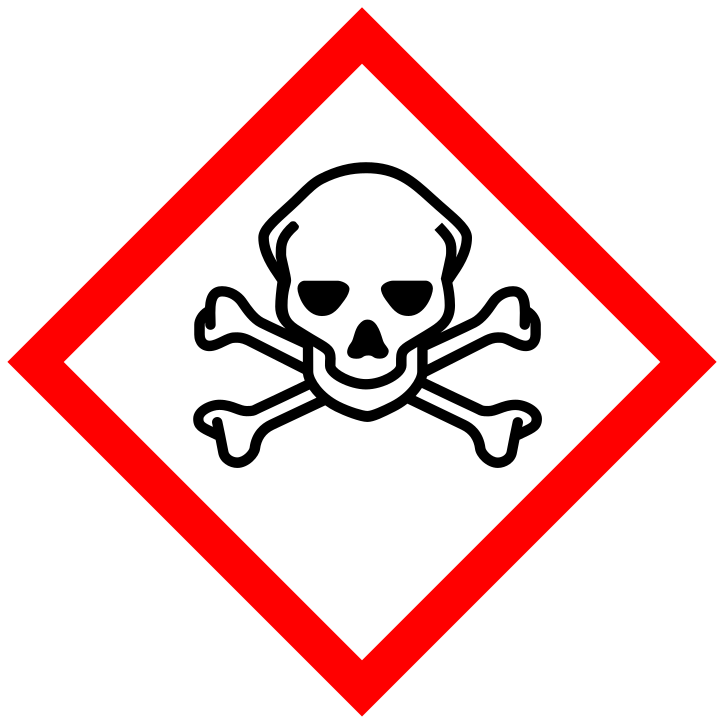
- Code
- GHS06
- Symbol
- Skull and crossbones
- Hazard
- Acute toxicity (severe)
- Signal word
- Danger
What it means
The skull and crossbones marks acute toxicity in the most severe categories (1 to 3): substances and mixtures that can be fatal or toxic after a single exposure by swallowing, skin contact or inhalation.
Hazard classes that trigger it
Classification in any of these categories puts GHS06 on the label, taken from the CLP label elements. A category with no signal word carries the pictogram alone.
| Category | H | Hazard statement | Signal word |
|---|---|---|---|
| Acute toxicity (oral) | |||
| Acute Tox. 1 (Oral) | H300 | Fatal if swallowed. | Danger |
| Acute Tox. 2 (Oral) | H300 | Fatal if swallowed. | Danger |
| Acute Tox. 3 (Oral) | H301 | Toxic if swallowed. | Danger |
| Acute toxicity (dermal) | |||
| Acute Tox. 1 (Dermal) | H310 | Fatal in contact with skin. | Danger |
| Acute Tox. 2 (Dermal) | H310 | Fatal in contact with skin. | Danger |
| Acute Tox. 3 (Dermal) | H311 | Toxic in contact with skin. | Danger |
| Acute toxicity (inhalation) | |||
| Acute Tox. 1 (Inhalation) | H330 | Fatal if inhaled. | Danger |
| Acute Tox. 2 (Inhalation) | H330 | Fatal if inhaled. | Danger |
| Acute Tox. 3 (Inhalation) | H331 | Toxic if inhaled. | Danger |
On candles, wax melts, reed diffusers and air sprays
A correctly formulated candle, wax melt, reed diffuser or air spray should not carry GHS06. The milder acute-toxicity category 4 uses the exclamation mark (GHS07) instead.
Live label demos: Candles · Wax melts & snap bars · Reed diffusers
Precedence rules involving this pictogram
-
Art. 26(1)(b)
If the hazard pictogram ‘GHS06’ applies, the hazard pictogram ‘GHS07’ shall not appear.
-
Art. 26(1)(e)
If the hazard pictogram ‘GHS02’ or ‘GHS06’ applies, the use of the hazard pictogram ‘GHS04’ shall be optional.
General reference, not legal advice: your label follows your own product’s classification.