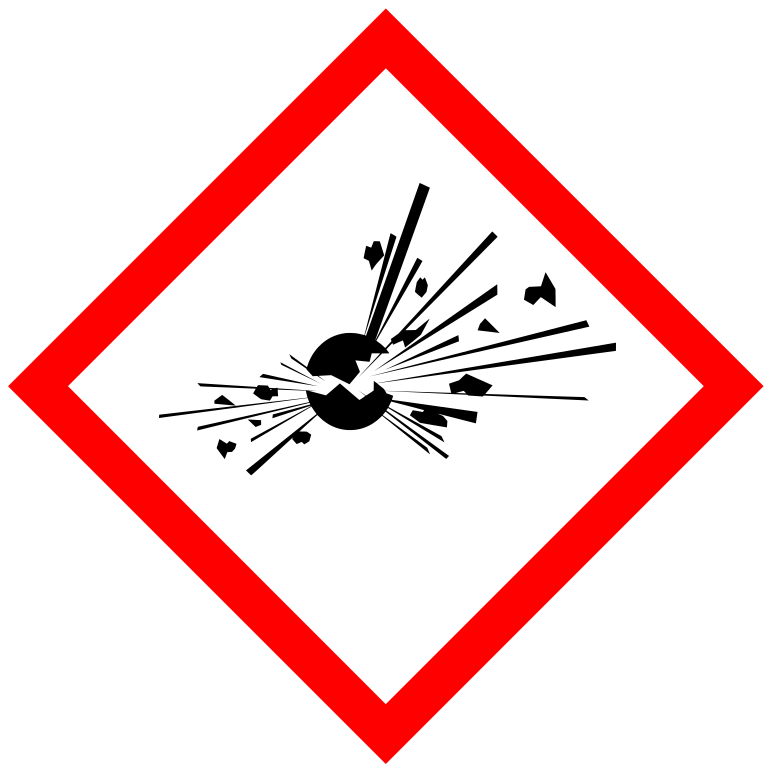
- Code
- GHS01
- Symbol
- Exploding bomb
- Hazard
- Explosive
- Signal word
- Danger Warning
What it means
The exploding bomb marks substances and mixtures that can explode — through shock, friction, fire or heat — and those that can decompose violently on their own, such as some self-reactive substances and organic peroxides.
It is a physical-hazard pictogram: it tells you how the product behaves, not how toxic it is.
Hazard classes that trigger it
Classification in any of these categories puts GHS01 on the label, taken from the CLP label elements. A category with no signal word carries the pictogram alone.
| Category | H | Hazard statement | Signal word |
|---|---|---|---|
| Explosives | |||
| Unst. Expl. | H200 | Unstable explosives. | Danger |
| Expl. 1.1 | H201 | Explosive; mass explosion hazard. | Danger |
| Expl. 1.2 | H202 | Explosive, severe projection hazard. | Danger |
| Expl. 1.3 | H203 | Explosive; fire, blast or projection hazard. | Danger |
| Expl. 1.4 | H204 | Fire or projection hazard. | Warning |
| Self-reactive substances and mixtures | |||
| Self-react. A | H240 | Heating may cause an explosion. | Danger |
| Self-react. B | H241 | Heating may cause a fire or explosion. | Danger |
| Organic peroxides | |||
| Org. Perox. A | H240 | Heating may cause an explosion. | Danger |
| Org. Perox. B | H241 | Heating may cause a fire or explosion. | Danger |
On candles, wax melts, reed diffusers and air sprays
You should not see this pictogram on a candle, wax melt, reed diffuser or air spray. Fragrance oils and waxes are not explosives; if an SDS for one of your materials shows GHS01, check it with the supplier.
Live label demos: Candles · Wax melts & snap bars · Reed diffusers
Precedence rules involving this pictogram
-
Art. 26(1)(a)
If the hazard pictogram ‘GHS01’ applies, the use of the hazard pictograms ‘GHS02’ and ‘GHS03’ shall be optional, except in cases where more than one of these hazard pictograms are compulsory.
General reference, not legal advice: your label follows your own product’s classification.