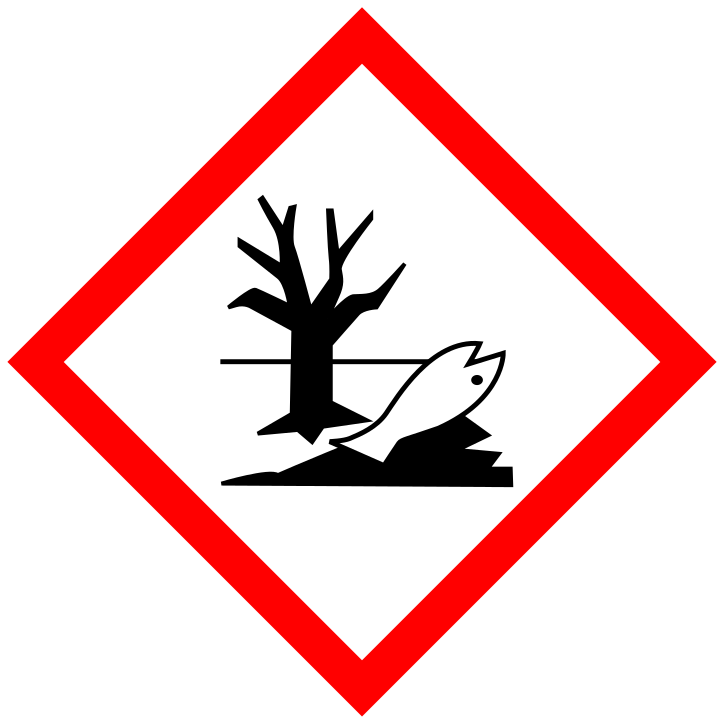
- Code
- GHS09
- Symbol
- Environment
- Hazard
- Hazardous to the aquatic environment
- Signal word
- Warning
What it means
The environment pictogram marks hazards to the aquatic environment: acute aquatic toxicity category 1 and chronic aquatic toxicity categories 1 and 2. The weaker chronic categories 3 and 4 have hazard statements but no pictogram.
Hazard classes that trigger it
Classification in any of these categories puts GHS09 on the label, taken from the CLP label elements. A category with no signal word carries the pictogram alone.
| Category | H | Hazard statement | Signal word |
|---|---|---|---|
| Hazardous to the aquatic environment — acute | |||
| Aquatic Acute 1 | H400 | Very toxic to aquatic life. | Warning |
| Hazardous to the aquatic environment — long-term | |||
| Aquatic Chronic 1 | H410 | Very toxic to aquatic life with long lasting effects. | Warning |
| Aquatic Chronic 2 | H411 | Toxic to aquatic life with long lasting effects. | None |
On candles, wax melts, reed diffusers and air sprays
Many fragrance materials are toxic to aquatic life — limonene, pinenes and several musks among them — and they are counted with M-factors, so a candle, wax melt, reed diffuser or air spray can reach Aquatic Chronic 2 (H411) and carry GHS09 even at a modest fragrance load. Aquatic Chronic 3 (H412) only adds the statement.
Live label demos: Candles · Wax melts & snap bars · Reed diffusers
Further reading
General reference, not legal advice: your label follows your own product’s classification.