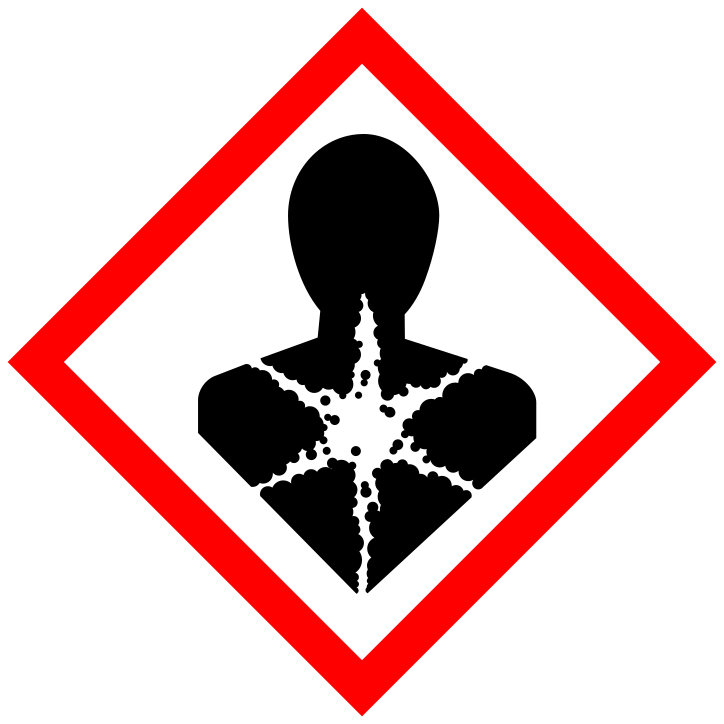
- Code
- GHS08
- Symbol
- Health hazard
- Hazard
- Serious health hazard
- Signal word
- Danger Warning
What it means
The health hazard pictogram marks serious, often long-term health effects: carcinogenicity, germ-cell mutagenicity, reproductive toxicity, respiratory sensitisation, specific target organ toxicity and aspiration hazard (H304, “may be fatal if swallowed and enters airways”).
Hazard classes that trigger it
Classification in any of these categories puts GHS08 on the label, taken from the CLP label elements. A category with no signal word carries the pictogram alone.
| Category | H | Hazard statement | Signal word |
|---|---|---|---|
| Respiratory sensitisation | |||
| Resp. Sens. 1 | H334 | May cause allergy or asthma symptoms or breathing difficulties if inhaled. | Danger |
| Resp. Sens. 1A | H334 | May cause allergy or asthma symptoms or breathing difficulties if inhaled. | Danger |
| Resp. Sens. 1B | H334 | May cause allergy or asthma symptoms or breathing difficulties if inhaled. | Danger |
| Germ cell mutagenicity | |||
| Muta. 1A | H340 | May cause genetic defects <state route of exposure if it is conclusively proven that no other routes of exposure cause the hazard>. | Danger |
| Muta. 1B | H340 | May cause genetic defects <state route of exposure if it is conclusively proven that no other routes of exposure cause the hazard>. | Danger |
| Muta. 2 | H341 | Suspected of causing genetic defects <state route of exposure if it is conclusively proven that no other routes of exposure cause the hazard>. | Warning |
| Carcinogenicity | |||
| Carc. 1A | H350 | May cause cancer <state route of exposure if it is conclusively proven that no other routes of exposure cause the hazard>. | Danger |
| Carc. 1B | H350 | May cause cancer <state route of exposure if it is conclusively proven that no other routes of exposure cause the hazard>. | Danger |
| Carc. 2 | H351 | Suspected of causing cancer <state route of exposure if it is conclusively proven that no other routs of exposure cause the hazard>. | Warning |
| Reproductive toxicity | |||
| Repr. 1A | H360 | May damage fertility or the unborn child <state specific effect if known > <state route of exposure if it is conclusively proven that no other routes of exposure cause the hazard>. | Danger |
| Repr. 1B | H360 | May damage fertility or the unborn child <state specific effect if known > <state route of exposure if it is conclusively proven that no other routes of exposure cause the hazard>. | Danger |
| Repr. 2 | H361 | Suspected of damaging fertility or the unborn child <state specific effect if known> <state route of exposure if it is conclusively proven that no other routes of exposure cause the hazard>. | Warning |
| Specific target organ toxicity — single exposure | |||
| STOT SE 1 | H370 | Causes damage to organs <or state all organs affected, if known> <state route of exposure if it is conclusively proven that no other routes of exposure cause the hazard>. | Danger |
| STOT SE 2 | H371 | May cause damage to organs <or state all organs affected, if known> <state route of exposure if it is conclusively proven that no other routes of exposure cause the hazard>. | Warning |
| Specific target organ toxicity — repeated exposure | |||
| STOT RE 1 | H372 | Causes damage to organs <or state all organs affected, if known> through prolonged or repeated exposure <state route of exposure if it is conclusively proven that no other routes of exposure cause the hazard>. | Danger |
| STOT RE 2 | H373 | May cause damage to organs <or state all organs affected, if known> through prolonged or repeated exposure <state route of exposure if it is conclusively proven that no other routes of exposure cause the hazard>. | Warning |
| Aspiration hazard | |||
| Asp. Tox. 1 | H304 | May be fatal if swallowed and enters airways. | Danger |
On candles, wax melts, reed diffusers and air sprays
On scented products it usually comes from the aspiration hazard: low-viscosity liquids rich in hydrocarbons such as limonene or pinene — including many reed diffuser liquids — can be Asp. Tox. 1 (H304). Solid candles and wax melts are not classified for aspiration, as the hazard applies only to liquids. A CMR ingredient above its limit would also bring GHS08.
Live label demos: Candles · Wax melts & snap bars · Reed diffusers
Precedence rules involving this pictogram
-
Art. 26(1)(d)
If the hazard pictogram ‘GHS08’ applies for respiratory sensitisation, the hazard pictogram ‘GHS07’ shall not appear for skin sensitisation or for skin and eye irritation.
Further reading
General reference, not legal advice: your label follows your own product’s classification.